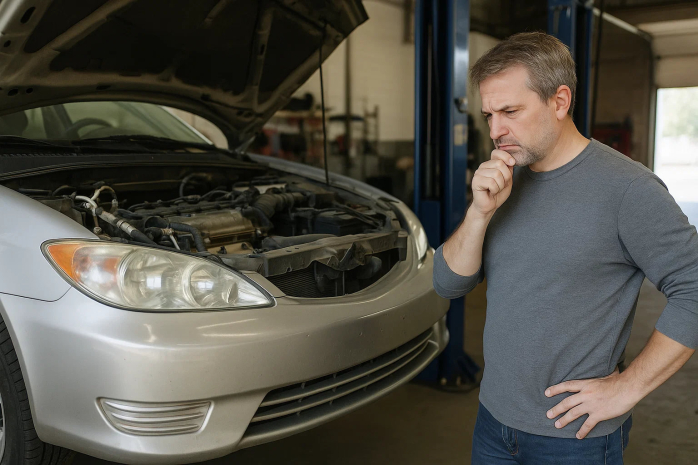
If your car stalled in water or you suspect water entered the engine, do not try to restart it. Stop cranking, get to safety and arrange a tow for inspection. Jump-starting or push-starting will not remove trapped liquid and can make the damage worse.
A hydrolocked engine has enough liquid in one or more cylinders to stop a piston from completing its stroke. Sometimes the engine can be recovered; sometimes it needs major repairs. The deciding factors are what entered the engine, how it stopped, whether anyone tried to restart it and what the inspection finds.
What Is Hydrolocking?
Hydrolocking, also called hydraulic lock or hydrostatic lock, happens when a piston tries to compress liquid instead of the normal air-fuel charge. Air compresses readily; liquid does not compress enough for the engine to complete its normal cycle. The resulting force can stop the crankshaft or bend and break internal components.
Water in the engine bay is not the same as water inside a cylinder. A wet ignition connector can cause a misfire without hydrolock, and water in the crankcase can contaminate the oil without locking a piston. All require attention, but the diagnosis and repair are different.
Hydrolocked Engine Symptoms: What to Look For
The strongest clue is the sequence of events: the engine took in water, stopped suddenly and now will not crank normally. Do not attempt another start just to check these symptoms.
| Symptom or observation | What it may mean | What to do next |
|---|---|---|
| Engine stalls while driving through standing water | Water ingestion is possible; wet electrical components can also cause a stall | Leave the engine off and arrange professional recovery |
| A clunk, brief movement or no normal cranking after water exposure | A cylinder may be blocked by liquid; a battery or starter fault is another possibility | Do not jump-start or keep turning the key |
| A bang or metallic knock when the engine stops | Possible connecting-rod, piston or other internal damage | Tell the shop exactly when the sound occurred |
| Wet air filter or water in the airbox | Evidence that water reached the intake, but not proof of cylinder damage | Have the full intake path and cylinders inspected |
| Milky oil, an unexpectedly high oil level or water on the dipstick | Possible water or coolant contamination of the lubrication system | Do not run the engine; request fluid inspection |
| Coolant loss, persistent white exhaust smoke or rough running before the failure | Possible internal coolant leak; these symptoms are not specific to hydrolock | Request cooling-system and engine testing |
A fully hydrolocked motor cannot rotate normally while liquid blocks a cylinder. An engine that still cranks or runs roughly may have water-related damage without being completely locked. A quiet stall does not rule out damage, and a knocking sound is not required for hydrolock to occur.
What Causes a Hydrolocked Engine?
- Water through the air intake: floodwater, deep puddles or a bow wave can reach the intake and be drawn into the cylinders.
- A low or damaged intake: some aftermarket cold-air intakes place the filter closer to road water. Loose ducting or missing seals can increase exposure.
- Coolant entering a cylinder: a failed head gasket, cracked cylinder head or block, or another engine-specific internal leak can allow liquid to accumulate.
- Excess fuel: a leaking or stuck-open injector can fill a cylinder in uncommon cases. This differs from the ordinary fuel-flooded no-start condition.
- Other internal fluid leaks: substantial oil entry can also create hydraulic lock, depending on the failure.
Heavy rain alone does not normally hydrolock a sound engine. The important question is whether liquid reached the combustion chamber. For broader damage to the cabin, wiring and drivetrain, see our guide on what to do if your car is flooded.
What Happens If Water Gets in Your Engine?
The damage depends on liquid volume, engine design, engine speed and load, time submerged and restart attempts. Low RPM is not a guarantee of a harmless outcome. Higher engine speed can increase the forces involved, but road speed alone cannot tell you how much water entered.
- Bent or broken connecting rods and damaged pistons.
- Damage to bearings, the crankshaft, cylinder walls or engine block.
- Corrosion and abrasive contamination from dirty or salt water.
- Loss of lubrication if water or fuel contaminates the oil.
Removing the water does not straighten a bent rod. Even an engine that starts again may have hidden damage. Persistent knocking, misfires or uneven compression after recovery need investigation before the car returns to service.
Hydrolock vs. a Seized Engine or a Fuel-Flooded Engine
| Condition | What is happening | How the diagnosis differs |
|---|---|---|
| Hydrolocked engine | Liquid prevents normal piston movement | Check liquid entry and mechanical condition before any restart |
| Mechanically seized engine | Internal parts bind because of damage, overheating, corrosion or lubrication failure | Identify the mechanical obstruction; removing liquid alone may not help |
| Fuel-flooded engine | An overly rich mixture prevents normal ignition; the engine often still cranks | Diagnose fuel and ignition faults; enough accumulated liquid fuel can rarely cause true hydrolock |
| Battery or starter problem | The starting system cannot rotate the engine normally | Electrical testing is needed; clicking alone does not identify the cause |
Read more about a seized engine and repair options if the shop finds mechanical binding rather than trapped liquid.
How to Fix a Hydrolocked Engine
What you should do first
- Stop trying to start it. Do not rev it to clear water or use a jump-start, push-start or tow-start.
- Prioritize safety. Do not enter moving floodwater or attempt roadside engine work in an unsafe location. Call emergency services if people are in danger.
- Document the event when safe. Note the water level, whether the engine was running, any noises and all restart attempts.
- Arrange a tow. Tell the recovery service that the vehicle has water exposure and may have a locked engine.
- Contact your insurer before major work if the damage may be covered, and keep inspection reports and receipts.
What a repair shop checks
There is no single safe procedure for every gasoline or diesel engine. A technician follows the service information for your exact engine, disables starting, fuel and ignition as required, checks the intake and determines which cylinders contain liquid. Removing spark plugs, glow plugs or injectors is engine-specific work; high-pressure fuel systems need particular care.
The shop removes trapped liquid without forcing the engine against it, services contaminated oil and filters, and identifies the entry point. Intake ducting and, where fitted, turbocharger plumbing or an intercooler may retain liquid that must be addressed before a controlled restart. A coolant or injector leak must be repaired or the problem can return.
Further checks may include borescope inspection, compression and leak-down testing, cooling-system tests and inspection for metal in the oil. Results must be assessed against manufacturer specifications; teardown may still be needed to confirm internal damage. Replacing every fuse, adding a cleaning additive or simply letting the car dry is not a hydrolock repair.
If the car was submerged, the inspection must also consider drivetrain fluids and electrical systems. A hybrid can have both a combustion engine and high-voltage components: do not handle orange cables, a flooded traction battery or electrical connectors. Use a qualified recovery and repair service.
How Much Does It Cost to Fix a Hydrolocked Motor?
There is no reliable flat price for hydrolock. Liquid removal without internal damage is a different job from an engine rebuild. For a replacement engine, a broad U.S. planning range is roughly $2,000 to more than $10,000, depending on the vehicle, engine source and work included. This is a general engine-replacement range, not an average hydrolock repair quote.
| Inspection result | Likely repair scope | What to ask about the estimate |
|---|---|---|
| No confirmed internal damage | Liquid removal, intake service, contaminated fluids and testing | Does it include finding the source and checking engine condition? |
| Bent rod, piston or bearing damage | Teardown, machining and rebuild, or replacement | Compare the full installed cost and warranty of each option |
| Cracked block or extensive internal damage | Replacement may be more practical | Is the engine used, rebuilt, remanufactured or new? What does the warranty cover? |
| Engine plus cabin or electrical flooding | Vehicle-wide assessment beyond the engine | Are wiring, safety systems, drivetrain fluids and corrosion included? |
Ask for an itemized estimate showing diagnosis, labor, parts, fluids, taxes and any towing or storage fees. Diesel, luxury and performance vehicles can exceed broad ranges. A low advertised engine price may exclude installation and supporting parts.
Does Insurance Cover a Hydrolocked Engine?
Comprehensive auto coverage may cover engine water damage from a covered flood event, subject to the deductible, policy terms and exclusions. Liability-only insurance does not pay for damage to your own engine. Hydrolock from wear, poor maintenance or an internal mechanical failure may be treated differently. Explain what happened accurately and ask your insurer to confirm coverage before authorizing major repairs.
Repair or Sell a Car With a Hydrolocked Engine?
Get the diagnosis before assuming the car is totaled. Repair may make sense when the rest of the car is sound, damage is limited and the installed repair has a useful warranty. Selling as-is may be more practical when engine work, other flood damage and existing repair needs outweigh the value of keeping the vehicle.
Compare the full repair cost with the car's realistic value after repair and a firm as-is offer. Include downtime and possible additional damage. An insurance total-loss decision follows applicable state rules and the insurer's assessment; there is no universal percentage that applies to every car.
If you decide to sell, JunkCarsUs is a junk car buyer that can provide an instant offer. Describe the water exposure, known engine damage, title status and whether it runs. You can review options for selling a non-running car, selling a totaled vehicle or selling a wrecked car, depending on its condition.
Ask about free junk car removal, pickup availability and required ownership documents. If an insurance claim is open or there is a lien, resolve who can authorize the sale before transferring the car. Disclose known flood damage.
How to Prevent Hydrolocking Your Car
- Avoid flooded roads and standing water of uncertain depth. Turn around rather than testing whether the intake stays dry.
- Keep intake ducting, the airbox and seals intact. Consider water exposure before installing a lower-mounted intake.
- Investigate unexplained coolant loss, overheating and fuel-system faults promptly.
- Keep water out of the air intake when cleaning the engine bay and follow the vehicle manufacturer's instructions.
- Move a parked car away from a flood-prone area before conditions become dangerous, when it is safe to do so.
A higher air intake does not make a vehicle floodproof. Water can still affect electrical components, brakes, cabin materials and drivetrain fluids.
FAQ
Will a hydrolocked engine turn over?
A fully hydrolocked engine cannot complete normal rotation while enough liquid remains in a cylinder. It may stop abruptly or refuse to crank. A clicking starter alone does not prove hydrolock; battery, starter and mechanical faults can produce similar symptoms.
Can a hydrolocked engine be fixed?
Sometimes. If there is no internal damage, a technician may remove the liquid, correct its source and service contaminated fluids and intake parts. Bent rods, damaged pistons or a cracked block can require a rebuild or replacement.
Can water in an engine dry out on its own?
Do not rely on waiting for it to dry. Liquid may remain in cylinders or intake components, and contaminated oil cannot protect the engine properly. Arrange inspection promptly and do not restart it to speed up drying.
Does milky oil always mean hydrolock?
No. Milky oil suggests moisture or coolant contamination, but it does not establish that a cylinder is hydraulically locked. Residue only under the oil cap can also result from condensation. A technician must identify the source.
Can heavy rain cause hydrolock?
Rain falling on a properly maintained vehicle normally does not cause hydrolock. The main concern is standing water entering the intake, or water entering through damaged or poorly positioned intake components. There is no universal safe puddle depth.
How much does it cost to fix a hydrolocked engine?
The cost depends on whether liquid removal and servicing are enough or internal engine repairs are needed. Engine replacement can cost roughly $2,000 to more than $10,000, depending on the vehicle and scope. Get an itemized diagnosis before deciding.
Is a hydrolocked engine automatically a total loss?
No. Hydrolock describes an engine condition, not an insurance decision. Total-loss treatment depends on the full repair estimate, vehicle value and applicable state rules. A damaged engine in an otherwise valuable vehicle may still be worth replacing.

 Like
 x.com