Catalytic converter replacement commonly costs about $1,000–$4,000 in the U.S., including parts and labor. A lower-priced approved aftermarket unit may bring the bill down, while an OEM exhaust-manifold assembly or multiple failed converters can push it higher. The right estimate depends on your vehicle, location and emissions requirements.
Before approving the repair, confirm that the converter actually failed. A check engine light, a failed emissions test or a rotten-egg smell alone does not prove you need a new one. Here is how to read the quote, avoid paying for the wrong repair and decide whether fixing the car makes financial sense.

How Much Does Catalytic Converter Replacement Cost in 2026?
AAA gives a broad installed range of $1,000–$4,000. For a narrower national benchmark, RepairPal's estimate updated September 3, 2026 is $2,280–$2,480: $2,044–$2,133 for parts and $236–$347 for labor. These estimates use different vehicle mixes and methods; neither is a quote for your car.
| Cost item | U.S. budget reference | What to confirm |
|---|---|---|
| Converter part | About $300–$2,500 in AAA's broad guide | OEM or aftermarket, exact part number, emissions approval and number of converters |
| Installation labor | $236–$347 in RepairPal's national estimate | Quoted hours and hourly rate; rust, welding and difficult access may add work |
| Complete replacement | Broadly $1,000–$4,000; some jobs fall outside this range | Parts plus labor, with taxes and additional repairs identified separately |
| Diagnosis and related repairs | Separate, vehicle-specific charges | Diagnostic fee, exhaust leaks, damaged pipes, sensors and the original cause of failure |
Budget references checked October 26, 2026 using AAA's cost guide and RepairPal's estimator. RepairPal excludes taxes, fees, location adjustments and related repairs. Do not add the broad parts range to the national labor range as if they described the same job.
Catalytic Converter Replacement Cost by Vehicle
The following RepairPal model-level estimates show how much the installed price can vary. They are reference ranges across a nameplate, not prices for every model year, engine, trim or emissions package. Check your VIN and local shop quote before budgeting.
| Vehicle | Published installed estimate |
|---|---|
| Ford F-150 | $1,591–$1,656 |
| Toyota Camry | $1,872–$1,950 |
| Toyota Corolla | $2,039–$2,103 |
| Honda Accord | $2,737–$2,916 |
| Honda Civic | $2,591–$3,673 |
| Nissan Altima | $1,577–$1,682 |
| Chevrolet Silverado 1500 | $2,928–$3,063 |
OEM vs. Aftermarket: What Changes the Price?
Two separate choices affect the quote: who makes the converter and how it installs. A direct-fit converter can be either OEM or aftermarket. A universal converter is not automatically a legal or suitable replacement just because its pipe diameter matches.
- OEM converter: supplied through the vehicle manufacturer for the specified application. It can cost considerably more, especially when built into the exhaust manifold.
- Aftermarket direct-fit converter: designed to bolt into a listed application. Confirm the correct engine, emissions certification, position and warranty before comparing it with an OEM quote.
- Universal converter: may require cutting, welding and fabrication. A lower part price can be offset by installation work, and it must still meet the applicable emissions requirements.
- CARB-compliant replacement: where required, the approved application and Executive Order number must match the vehicle. Check current requirements for the state where the car is registered.
In California, physical fit alone is insufficient: the aftermarket converter must be approved for the specific vehicle application. Other states can also impose stricter requirements than the federal baseline. Have the installer verify the underhood emissions label, engine family and current rules before ordering. A cheap part that cannot pass inspection is an expensive mistake.
What Raises Catalytic Converter Labor Cost?
Ask for the labor hours and rate separately. Rusted fasteners, broken studs, welded connections and a converter integrated into the manifold can make access and removal harder. A V6 or V8 may have several converters; replacing one bank is different from replacing an entire assembly. Dealer and independent-shop quotes may also use different parts, so compare equivalent work.
Can a Catalytic Converter Be Repaired Instead of Replaced?
The phrase “catalytic converter repair cost” can describe very different jobs. Tightening a heat shield or fixing a nearby leak is not the same as restoring the catalyst inside the housing. Get the diagnosis in writing so you know what the repair is meant to solve.
| Finding | Possible next step |
|---|---|
| Loose heat shield or mounting hardware | Repair the attachment if the surrounding metal is sound |
| Leaking flange, gasket or adjacent pipe | Repair the leak and retest; the converter may still work |
| Faulty sensor or wiring | Verify and repair the fault, then reassess catalyst performance |
| Melted, fractured or contaminated catalyst | Replace the affected converter and correct the cause |
| Converter stolen or cut out | Inspect pipes, wiring and sensors; quote a compliant replacement and any collateral damage |
A cleaning additive cannot rebuild a broken honeycomb or reverse physical melting. Avoid paying for repeated cleaners when testing has already confirmed a restriction or damaged catalyst. Ask what evidence supports any proposed cleaning treatment and what happens if it does not resolve the fault.
Symptoms and Diagnosis: Do P0420 or P0430 Mean Replacement?
P0420 means catalyst-system efficiency is below the expected threshold on bank 1; P0430 refers to bank 2. Neither code is an automatic instruction to replace the converter. Diagnosis should account for other engine faults, exhaust leaks and sensor operation.
- Record the trouble codes and operating conditions before clearing anything.
- Investigate misfires and fuel-control problems, then inspect for exhaust leaks.
- Test the relevant sensors and catalyst performance using the manufacturer's diagnostic procedure.
- If power loss suggests a restriction, have the shop check exhaust backpressure.
- Correct the cause of failure before installing a new converter.
A failed emissions test can have several causes. Rattling, unusual exhaust odor or poor acceleration should trigger inspection, not a parts order. A restricted converter can cause excessive exhaust backpressure, which reduces engine performance. A catalyst can also lose efficiency without becoming clogged.
What Does a Catalytic Converter Do, and Why Does It Fail?
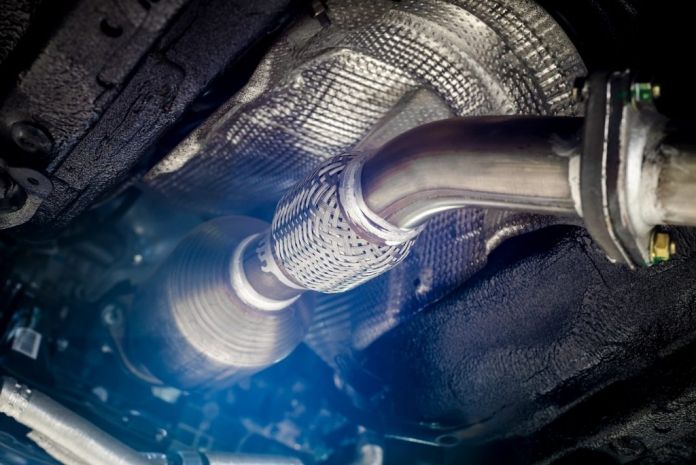
A catalytic converter treats harmful exhaust gases. On a typical gasoline vehicle, its ceramic or metallic honeycomb carries a catalyst coating that includes precious metals; the honeycomb is not a solid structure made from those metals. It is an emissions-control device, while the muffler has the main noise-control role.
Misfires, an overly rich fuel mixture, oil or coolant entering the exhaust and physical impact can damage a converter. Replacing it without addressing the engine problem risks another expensive failure. Tell the mechanic about oil consumption, coolant loss and recent engine work.
Can You Drive With a Bad Catalytic Converter?
Stop safely and arrange assistance if the check engine light flashes, the car loses substantial power, the converter glows red or exhaust fumes enter the cabin. Do not park an overheated exhaust over dry grass or other combustible material. An open or damaged exhaust also needs prompt attention.
A steady warning light with otherwise normal drivability does not establish a safe remaining mileage. Get the fault diagnosed promptly and ask whether the car should be towed. Emissions-test requirements vary by state, county and vehicle; passing or avoiding a local inspection does not make emissions-system tampering acceptable.
Check Emissions Warranty and Theft Coverage Before Paying
For 1995-and-newer light-duty vehicles, qualifying original catalytic-converter defects generally have federal emissions warranty coverage for 8 years or 80,000 miles, whichever comes first. This is separate from many shorter bumper-to-bumper warranties. Some vehicles have longer state or manufacturer coverage.
Ask the manufacturer or dealer to check your VIN, in-service date, mileage, diagnosed failure and any applicable recalls or warranty extensions. Coverage is not automatic for theft, collision damage or every cause of failure. Extended service contracts have their own exclusions. The EPA's emissions-warranty guidance explains the federal baseline.
If the converter was stolen, ask your insurer about comprehensive coverage and the deductible before authorizing repairs. Include damaged oxygen-sensor wiring and cut exhaust pipes in the inspection. Mechanical wear alone is generally a different issue from a theft claim.
Is Replacing the Catalytic Converter Worth It?
Replacement can make sense when the engine and transmission are healthy and the repair will keep a reliable car in service. Compare the full repair bill with the car's realistic value, other upcoming repairs and the cost of obtaining another vehicle. There is no fixed percentage that works for every owner.
- Keeping the car: include the converter, diagnosis, underlying engine repair and other work needed for reliable use.
- Repairing before selling: compare the expected sale price after repairs minus all repair costs with a firm as-is offer.
- Selling as-is: disclose a damaged or missing converter and compare offers that include pickup and any fees.
For example, if a car would sell for $4,000 after a $2,500 repair, that leaves $1,500 before other selling costs. A $1,700 as-is offer would produce more cash in that example. These are illustrative numbers, not vehicle valuations or JunkCarsUs offers. Keeping the car may still be sensible if replacing it would cost much more.
If repairs no longer fit your budget, we can give you an offer for the vehicle in its current condition. Tell us whether the catalytic converter is present and whether the car runs. We buy damaged vehicles and non-running cars, with free towing arranged for accepted pickups. Use our scrap car value calculator as a starting point, or request a vehicle-specific offer before spending money on repairs.
What to Ask Before Approving a Replacement Quote
- Which converter failed, and what testing confirmed the failure?
- Does the estimate cover one converter, both banks or a complete assembly?
- What is the part number, and is it correct for my emissions application?
- Are diagnosis, labor, taxes, gaskets and hardware included?
- Do the sensors actually need replacement, or are they being listed as a precaution?
- What caused the failure, and is correcting it included?
- What parts-and-labor warranty applies, and has manufacturer coverage been checked?
Catalytic Converter Replacement FAQ
How much does it cost to replace a catalytic converter?
Budget roughly $1,000–$4,000 installed for many U.S. vehicles. Some approved aftermarket replacements cost less, while OEM assemblies and vehicles needing multiple converters can cost more. Get a quote for your exact year, engine, emissions specification and ZIP code.
Can a catalytic converter be repaired instead of replaced?
A loose heat shield, leaking flange or nearby exhaust pipe may be repairable. A melted, broken or chemically damaged catalyst generally needs replacement. Diagnose the problem before paying for a converter or a cleaning treatment.
Does P0420 or P0430 mean I need a new catalytic converter?
Not by itself. These codes report catalyst efficiency below the expected threshold on bank 1 or bank 2. A shop should check other engine codes, exhaust leaks and sensor operation before confirming that the converter has failed.
Can I drive with a bad catalytic converter?
Do not keep driving with a flashing check engine light, severe power loss, a glowing converter or exhaust fumes in the cabin. Stop safely and arrange assistance. A steady warning light with normal drivability still needs prompt diagnosis; it does not establish how long the car can safely be driven.
Will catalytic converter cleaner fix a clogged converter?
An additive cannot rebuild a melted or broken honeycomb or restore a catalyst damaged by contamination. Do not rely on cleaner to cure a confirmed restriction or guarantee an emissions-test pass. Fix the underlying engine or exhaust problem first.
Is catalytic converter replacement covered by warranty or insurance?
Qualifying defects in original catalytic converters on 1995-and-newer light-duty vehicles generally have federal emissions coverage for 8 years or 80,000 miles, whichever comes first. Check the manufacturer for eligibility and any longer coverage. Theft may be covered by comprehensive auto insurance, subject to the policy and deductible; extended service contracts vary.
Do I need to replace both catalytic converters?
Not automatically. Ask which converter or bank failed and how it was tested. Some parts are sold as a complete assembly, but the estimate should explain why more than one converter needs replacement.
Can I sell my car with a bad or missing catalytic converter?
You can request an as-is offer from JunkCarsUs and disclose whether the converter is damaged or missing. The offer depends on the vehicle, its remaining parts and location. Ask about ownership paperwork, pickup and any local transfer requirements before agreeing to the sale.

 Like
 x.com