Car suspension repair cost depends on the failed part and how many components need replacing. Current U.S. estimates range from about $130–$185 for a stabilizer bar link kit replacement to $1,144–$1,348 for a shock or strut replacement service. Those are different repair jobs, not a guaranteed minimum and maximum. A multi-part suspension rebuild can cost several thousand dollars.
Before approving a repair, check whether the price covers one side, a left-and-right pair, one axle, or all four corners. Parts, labor, alignment, taxes, and damage from rust or a collision can change the final bill substantially.
Common Suspension Repairs and Their Costs
The table below shows RepairPal's national U.S. service estimates, updated September 3, 2026 and checked October 29, 2026. Parts and labor are included; taxes, fees, location adjustments, and additional repairs are excluded. The listed service names do not establish a universal quantity for every vehicle. Ask the shop to state the number and position of parts in your estimate.
| Repair or service | Parts and labor estimate | What to confirm in your quote |
|---|---|---|
| Stabilizer bar link kit replacement | $131–$185 | One link or a pair; front or rear |
| Tie rod replacement | $258–$300 | Inner or outer tie rod; number of sides; alignment extra |
| Suspension ball joint replacement | $307–$452 | Upper or lower joint; separate joint or complete arm |
| Control arm bushings replacement | $321–$437 | Which bushings; pressing labor versus a complete arm |
| Coil spring replacement | $758–$925 | One spring or an axle pair; mounts and insulators |
| Control arm replacement | $791–$909 | Number of arms; whether bushings and ball joint are included |
| Suspension shock or strut replacement | $1,144–$1,348 | Shocks or struts; quantity; bare units or complete assemblies |
| Wheel alignment | $186–$273 | Whether already included in the repair total |
These figures are reference points for comparing written estimates, not JunkCarsUs repair quotes. A specific vehicle can fall outside them. Do not add every row together: a complete control arm may already include the ball joint and bushings, and a complete strut assembly may include the spring and upper mount.
Front vs. Rear Suspension Repair Cost
There is no fixed front suspension repair cost or rear suspension repair cost. A rear shock replacement may be simpler than a front strut job, while a rear air suspension fault or corroded multi-link setup can be much more expensive. The failed component matters more than which end of the car it sits on.
- Front suspension: quotes may include struts, control arms, ball joints, sway bar links, and related steering work such as tie rod ends.
- Rear suspension: quotes may include separate shocks and springs, struts, trailing arms, control arms, or air springs, depending on the design.
- Per axle: means the left and right sides at the front or rear. It does not mean all four corners.
- All four corners: usually means four shocks or struts. It does not automatically include every arm, joint, spring, or bushing.
How Much Does a Full Suspension Replacement Cost?
A full suspension replacement has no standard parts list. Replacing four dampers is a different job from rebuilding the front and rear suspension after years of wear. Ask for an itemized list before comparing totals.
For budgeting, a multi-component job can reach several thousand dollars, especially with electronic dampers, air suspension, corrosion, or impact damage. Rather than relying on a single whole-car average, price the diagnosed components for your year, make, model, and ZIP code.
Illustrative example: if a shop quotes $1,200 for a front strut pair, $600 for rear shocks, and $200 for alignment, the subtotal is $2,000 before taxes and fees. Those example prices demonstrate the calculation; they are not national averages or a quote for your vehicle. Control arms, tires, or structural repairs would be separate unless listed.
What Is a Car Suspension System?
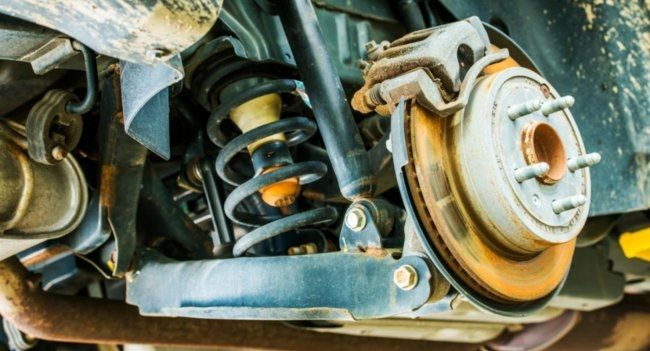
Your suspension connects the wheels to the body and helps the tires maintain contact with the road. Springs carry the vehicle's weight and allow wheel travel. Shock absorbers control spring movement. Struts combine damping with a structural role in the suspension; control arms, bushings, and joints locate the wheels while allowing movement. Steering parts work with this system but perform a different job.
Shock Absorbers and Struts: Repair or Replacement?
Ordinary worn shocks and struts are generally replaced, rather than repaired internally. “Car shockers” is another term for shock absorbers in some markets; it does not specifically mean adjustable or electronic dampers.
Shocks and struts are usually replaced as a matched left-and-right pair on the same axle. Ask whether a strut quote includes the spring, mount, bearing, boot, and bump stop or just the damper. A complete assembly can reduce disassembly labor, but the correct option depends on the car and the condition of the existing parts.
Control Arms, Bushings, Springs, and Ball Joints
A cracked bushing does not always require every control arm to be replaced. Some bushings and ball joints are separately serviceable; others are supplied as part of an arm. Compare the installed cost of pressing in a bushing with replacing the complete assembly, including any overlapping labor.
Broken or sagging springs need an inspection of ride height, spring seats, and related components. A car leaning to one side can have a spring or air suspension problem; replacing shocks alone may not correct it.
What Makes a Suspension Repair Quote More Expensive?
- Vehicle and suspension type: adaptive dampers, air springs, compressors, and ride-height sensors require different parts and diagnostic procedures from conventional suspension.
- Parts choice: compare reputable aftermarket and original-equipment options with the same specifications and warranty. The cheapest listing may exclude mounts or hardware.
- Labor and corrosion: access, seized bolts, broken fasteners, and regional shop rates affect the installed price.
- Related damage: a pothole or curb strike may also damage a tire, wheel, steering component, or subframe.
- Alignment and setup: ask whether the repair requires alignment, ride-height setup, or a manufacturer-specified calibration, and whether those charges are included.
Do You Need an Alignment After Suspension Work?
Plan for an alignment check after replacing struts or parts that affect wheel position, such as control arms or tie rods. Follow the vehicle manufacturer's procedure. Replacing a separate shock absorber may not change alignment geometry.
An alignment cannot fix a bent arm, loose joint, or damaged mounting point. If the shop cannot bring the angles within specification, it should identify the underlying damage instead of repeatedly adjusting the car.
Signs You Need Suspension Repairs—and When to Stop Driving
A symptom helps narrow the inspection; it does not prove which part has failed.
| What you notice | What the shop should inspect | Next step |
|---|---|---|
| Clunking or rattling over bumps | Links, bushings, joints, and mounts | Arrange an inspection; do not order struts based on noise alone |
| Repeated bouncing, nose dive, or excessive body roll | Dampers and related suspension components | Have handling and damping checked promptly |
| Pulling or uneven tire wear | Tire pressure and condition, alignment, steering, and suspension | Diagnose the cause before replacing tires or adjusting alignment |
| One corner sits low or the car drops overnight | Springs, air leaks, ride-height controls, and mounting points | Get an inspection; a damper alone may not be the cause |
| Wheel visibly displaced, tire rubbing, severe instability, or sudden steering change | Possible joint, arm, spring, steering, or structural failure | Stop in a safe place and arrange towing |
Can you drive with bad suspension? There is no reliable safe mileage allowance. Mild noise still needs diagnosis, while a broken spring, loose ball joint, damaged tie rod, or major handling change can make driving unsafe. Do not road-test a vehicle that feels unstable.
After an impact, ask the shop to check the subframe, strut towers, suspension mounting points, and surrounding corrosion. If more than suspension parts are affected, our guide to undercarriage damage and repair decisions explains what else to consider.
How to Compare Quotes and Reduce Suspension Repair Costs
- Get a diagnosis first. Ask which component failed and what evidence supports replacement.
- Compare the same scope. Match the number of parts, axle, brand, assembly type, warranty, and alignment allowance.
- Check overlapping work. Ask whether doing related repairs together reduces labor, and whether included bushings or joints have been charged twice.
- Separate urgent repairs from optional work. Replace unsafe or failed parts; ask the shop to justify additional recommendations by condition.
- Request the installed total. Include diagnostic charges, hardware, shop supplies, alignment, taxes, and any setup work. Ask before authorizing extra work for seized bolts.
DIY savings depend on the job and your equipment. Spring disassembly stores enough energy to cause severe injury, and suspension work requires safe vehicle support and correct torque procedures. A complete assembly does not remove every installation risk.
Is Suspension Repair Worth It, or Should You Sell the Car?
Suspension wear alone does not make an otherwise dependable car a junk car. Repair may make sense when the body, engine, and transmission are sound and the quote restores reliable use for less than replacing the vehicle.
Consider selling as-is when suspension work comes with serious rust, damaged mounting points, recurring major repairs, or a total bill you cannot justify. Compare the repair cost plus other necessary work with the car's likely value after repair, its as-is offer, and the cost of replacement transportation.
For example: a car worth $4,000 after repair, with $2,500 of required work and an as-is offer of $1,200, leaves only a $300 difference if you repair solely to sell: $4,000 − $2,500 − $1,200. That illustrative margin could disappear with added costs. Keeping a repaired car for dependable daily use is a different calculation.
JunkCarsUs buys damaged cars, including vehicles with suspension problems. You can compare an as-is offer with your repair estimate or use our scrap car value calculator as a starting point. Describe the damage and whether the wheels roll and steer so pickup can be planned safely. Request an offer before deciding whether to repair or sell.
Suspension Repair Cost FAQs
How much does it cost to fix suspension on a car?
It depends on the diagnosed part and quantity. The service estimates above range from $131–$185 for a stabilizer bar link kit to $1,144–$1,348 for shock or strut replacement. A complete rebuild can cost more. Get a vehicle-specific installed quote.
Do I have to replace all four shocks or struts?
Not automatically. Matched pairs on the same axle are generally recommended; the other axle should be inspected and replaced according to condition and manufacturer guidance.
Is a $2,000 suspension repair quote reasonable?
It can be for multiple components, premium parts, or work at several corners. It cannot be judged from the total alone. Request the parts, quantities, labor, and alignment breakdown, then compare an equivalent second quote.
How long does suspension repair take?
A straightforward repair may be completed in one shop visit, while extensive work, seized hardware, parts delays, and alignment scheduling can extend it. Ask for both labor time and the expected vehicle pickup time.
Cost references: RepairPal U.S. estimates for the services listed above. Technical guidance cross-checked with Monroe's shock and strut resources. Prices are estimates, not guaranteed local quotes. Content reviewed and updated October 29, 2026.

 Like
 x.com